Malady: Poor eMR system design
Myth: Interruptive eMR alerts are effective interventions to prevent clinician errors
Remedy: Interrupting people generally doesn’t change outcomes (and may lead to harm), and most clinicians ignore almost all of them anyway. There are more subtle ways to get these suggestions across, which are explored.
Guest Author: Dr Tom L.
About Tom: When not pontificating on mythology in medical settings, and confusing Pericles and Patroclus, Tom swears he will one day finish his medical training!
It is with great pleasure, and in fulfilment of a lifelong dream, that I write a short submission for this blog, and hope that you, as mythomaladites, enjoy reading it as much as I enjoyed writing it. Much like Achilles spending most of the Iliad sulking near his boat with Patroclus, only to emerge on the battlefields of Troy when things are getting a bit dicey, I now write this submission about a topic close to my heart.
INTERRUPTIVE ALERTS
Have you thought of that? Could your patient be frail? Stop! This could be SEPSIS! Hold on! This medication is dangerous – did you know that? Wait you dolt! Did you select this medical record by accident! Do you know its contents are private? Danger, Will Robinson – this record has an alert! (*)
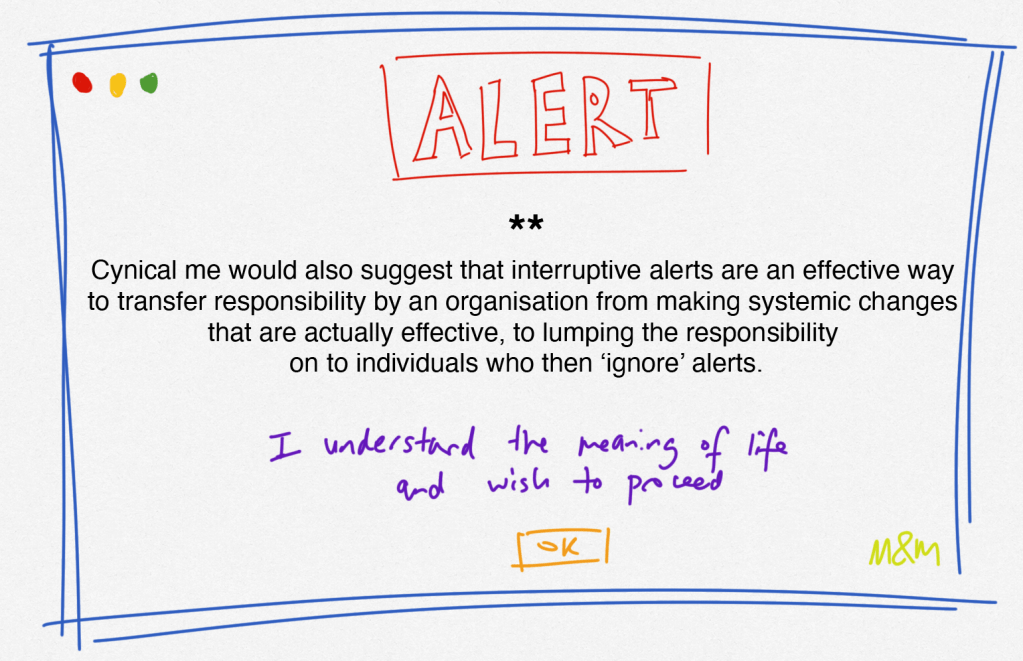
Interruptive alerts are very appealing to implement. Say as a clinician, I encounter a problem. Naturally, this generalises to all the other clinicians I work with – particularly those silly junior medical officers – and it is worthwhile to let them know about it too. Or alternatively, there’s been a terrible outcome for a person entering a hospital for one of an unfortunate multitude of reasons. What better way to ‘deal with the issue’ than issuing an alert to ‘generate awareness’… (**)
However, to adopt an unpopular example, much like the opinion of the Athenian elites who, perhaps, had been interrupted by dear Socrates one too many times, down with these hideous interruptions, I say.
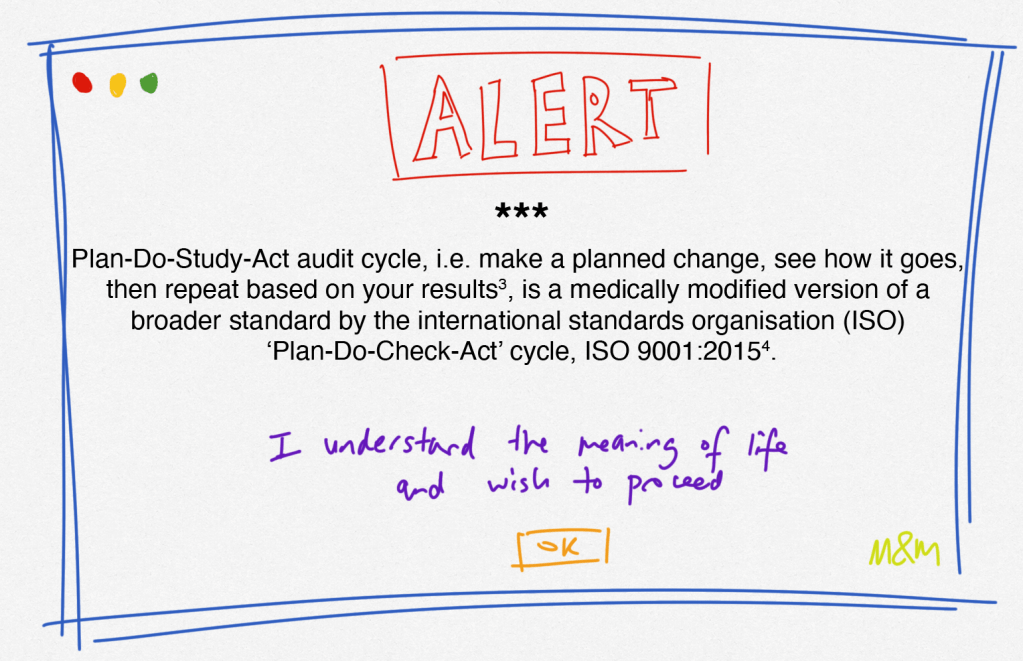
Firstly, these interventions are often not guided by evidence, or alternatively, certainly unsupported by evidence1. Throughout training there are years of dogmatic inculcation regarding the benefits of evidence-based medicine, yet for some reason there exists a specific exemption often applied to the technology we use. What is the sensitivity and specificity of the alert we are proposing for displaying when it should, or when it leads to meaningful change? I’ll bet you it is this: highly sensitive (i.e. appears all the time, thus covering all possible instances it is required), horribly non-specific (appears all the time for reasons it shouldn’t). And far be it for there to be any monitoring of the effects of these interventions once they are applied in practice! Count the famous PDSA cycle relating to alert implementation out (***).
Moreover, do these alerts result in any change at all? We’ll never know, because it’s so rarely measured at a local setting. But we do know in a general sense that alerts are rarely effective (e.g.1). In fact, in one recent amusing analysis of a sepsis prediction model, it turned out that sepsis predictions were close to flipping a coin once the human thoughts behind the predictions were removed – i.e. before mere humans had decided to order blood cultures, lactate, or commence antibiotics… so, not particularly earth-shattering then2.
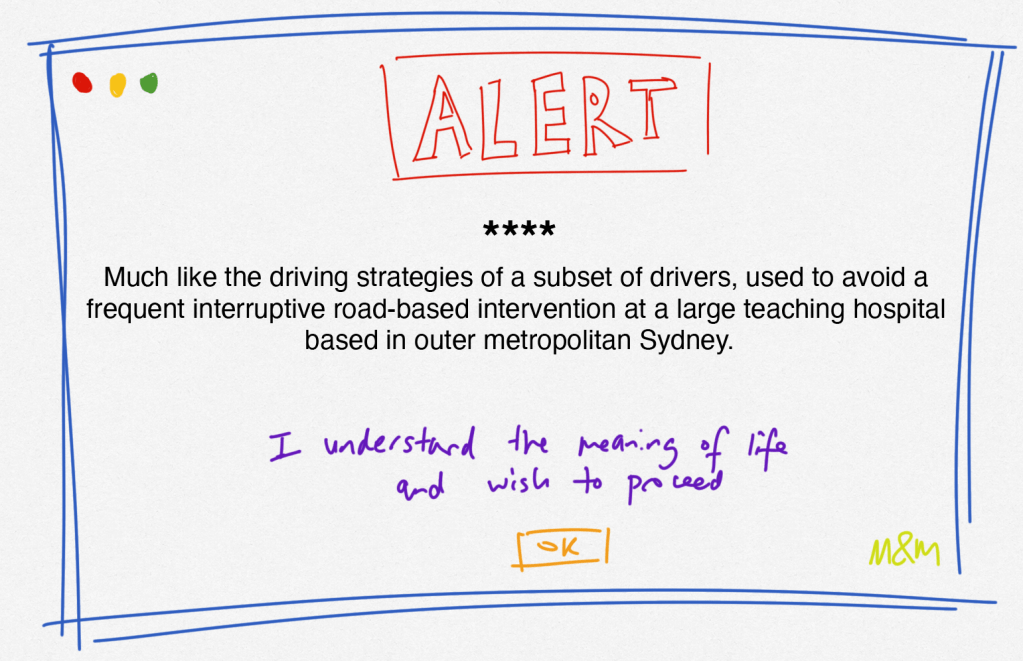
Secondly, real and measurable harms arise from inappropriate alerts. For example clinicians interrupted in the emergency department are 280% more likely to make errors5. Or, at a sort of meta level, there may be so many alerts that meaningful alerts are ignored, leading to potentially devastating consequences for patients6, termed ‘alert fatigue’7. One study reported override rates of drug-drug alerts between 95.1 – 99.3%8. In fact, the potential harms of digital systems, similar to the harms wrought by 10,000 triremes filled with Hellenes good at woodwork and interested in equestrian design styles, are manifold9,10. Humans develop workarounds to unhelpful digital health interventions (****), which can result in harm, or delays in investigations or treatment. There’s a whole online series dedicated to examples of digital health strategies that have room for improvement, including alerts, which is fascinating to read11.
Thirdly, there are lots of other interventions that can be trialled in a digital technology that are may be just as effective or ineffective12. For example, HYDROmorphone (don’t get the dose wrong!) using Tallman lettering13; providing pre-filled order sentences or order sets to select from; shifting default selections or ordering; using user interface design to draw the user’s attention to or away from elements, identifying to the user visually which elements are and aren’t mandatory, etc. These soft interventions, such as nudges, are myriad and often effective12. There are even ways to make alerts more specific when they are implemented – these include inactivating unhelpful alerts classes, such as minimum dosing alerts, refining alerts by providing more information to the user or incorporating more context to guide when alerts are generated14.
Fourth, alerts get so caught up in ensuring we become clinical lemmings that the patient becomes a distant abstraction to our care. Have you filled out the VTE assessment yet? Have you? Have you? This process metric doesn’t capture at all if you have separately made a clinical decision or if the patient has or hasn’t actually been charted VTE prophylaxis, let alone tying this to the outcome of a VTE. This problem also troubles research, which almost universally looks at whether clinicians accept or override alerts15,16, with a complete blind spot as to what actually happens to patients, which I think we would all argue, ought to be considered the crucial element in clinical care.
So, dear readers! Unlike Achilles I do hope to survive our encounter, and leave you with some food for thought. Evidence can and should apply to digital interventions, and think twice before you sit silently through someone else proposing an interruptive alert – and far be it, to propose one yourself!
Until next time!
Tom
Giants’ Shoulders:
O’Donnell, M., Fitzpatrick, E., Westbrook, J., Merchant, A. & Raban, M. Health Innovation Series. https://www.mq.edu.au/faculty-of-medicine-health-and-human-sciences/departments-and-schools/australian-institute-of-health-innovation/healthcare-tools-and-resources/health-innovation-series (2026).
Sutton, R. T. et al. An overview of clinical decision support systems: benefits, risks, and strategies for success. Npj Digital Medicine 3, 17 (2020).
Also Cited Above:
[1] Holbrook AM, Silva JM, Faruque JAY, Deng J, Schneider T, Jaffer A. Effect of electronic drug-drug interaction alerts on patient and clinician outcomes: a systematic review. J Am Med Inform Assoc. 2025;32(10):1617-1628. doi:10.1093/jamia/ocaf139
[2] Kamran F, Tjandra D, Heiler A, et al. Evaluation of Sepsis Prediction Models before Onset of Treatment. NEJM AI. 2024;1(3)doi:10.1056/aioa2300032
[3] Carnegie Foundation for the Advancement of T. Plan-Do-Study-Act Cycle.
[4] International Organization for Standardization. ISO 9001:2015 Quality management systems. 2015.
[5] Westbrook JI, Raban MZ, Walter SR, Douglas H. Task errors by emergency physicians are associated with interruptions, multitasking, fatigue and working memory capacity: a prospective, direct observation study. BMJ Qual Saf. 2018;27(8):655. doi:10.1136/bmjqs-2017-007333
[6] Adie SK, Barnes GD, Konerman MC. A Deadly Override. Circulation: Cardiovascular Quality and Outcomes. 2022;15(7):e009066. doi:10.1161/circoutcomes.122.009066
[7] Kane-Gill SL, O’Connor MF, Rothschild JM, et al. Technologic Distractions (Part 1): Approaches to Manage Alert Quantity With Intent to Reduce Alert Fatigue and Suggestions for Alert Fatigue Metrics. Crit Care Med. 2017;45(9):1481-1488. doi:10.1097/ccm.0000000000002580
[8] Phansalkar S, Sijs Hvd, Tucker AD, et al. Drug—drug interactions that should be non-interruptive in order to reduce alert fatigue in electronic health records. J Am Med Inform Assoc. 2013;20(3):489-493. doi:10.1136/amiajnl-2012-001089
[9] Sutton RT, Pincock D, Baumgart DC, Sadowski DC, Fedorak RN, Kroeker KI. An overview of clinical decision support systems: benefits, risks, and strategies for success. NPJ Digit Med. 2020;3(1):17. doi:10.1038/s41746-020-0221-y
[10] Coiera E, Ash J, Berg M. The Unintended Consequences of Health Information Technology Revisited. Yearb Med Inform. 2016;25(01):163-169. doi:10.15265/iy-2016-014
[11] O’Donnell M, Fitzpatrick E, Westbrook JI, Merchant A, Raban MZ. Health Innovation Series. 2026
[12] Raban MZ, Gates PJ, Gamboa S, Gonzalez G, Westbrook JI. Effectiveness of non-interruptive nudge interventions in electronic health records to improve the delivery of care in hospitals: a systematic review. J Am Med Inform Assoc : JAMIA. 2023;30(7):1313-1322. doi:10.1093/jamia/ocad083
[13] Bhat KR, Gutzwiller RS. Tall man lettering as a solution for look-alike sound-alike errors: A systematic literature review. Hum Factors Healthc. 2026;9:100123. doi:10.1016/j.hfh.2026.100123
[14] Ledger TS, Brooke-Cowden K, Coiera E. Post-implementation optimization of medication alerts in hospital computerized provider order entry systems: a scoping review. J Am Med Inform Assoc. 2023:ocad193. doi:10.1093/jamia/ocad193
[15] Luri M, Leache L, Gastaminza G, Idoate A, Ortega A. A systematic review of drug allergy alert systems. Int J Med Inform. 2022;159:104673. doi:10.1016/j.ijmedinf.2021.104673
[16] Page N, Baysari MT, Westbrook JI. A systematic review of the effectiveness of interruptive medication prescribing alerts in hospital CPOE systems to change prescriber behavior and improve patient safety. Int J Med Inform. 2017;105:22-30. doi:10.1016/j.ijmedinf.2017.05.011
Discover more from Myths & Maladies
Subscribe to get the latest posts sent to your email.

